
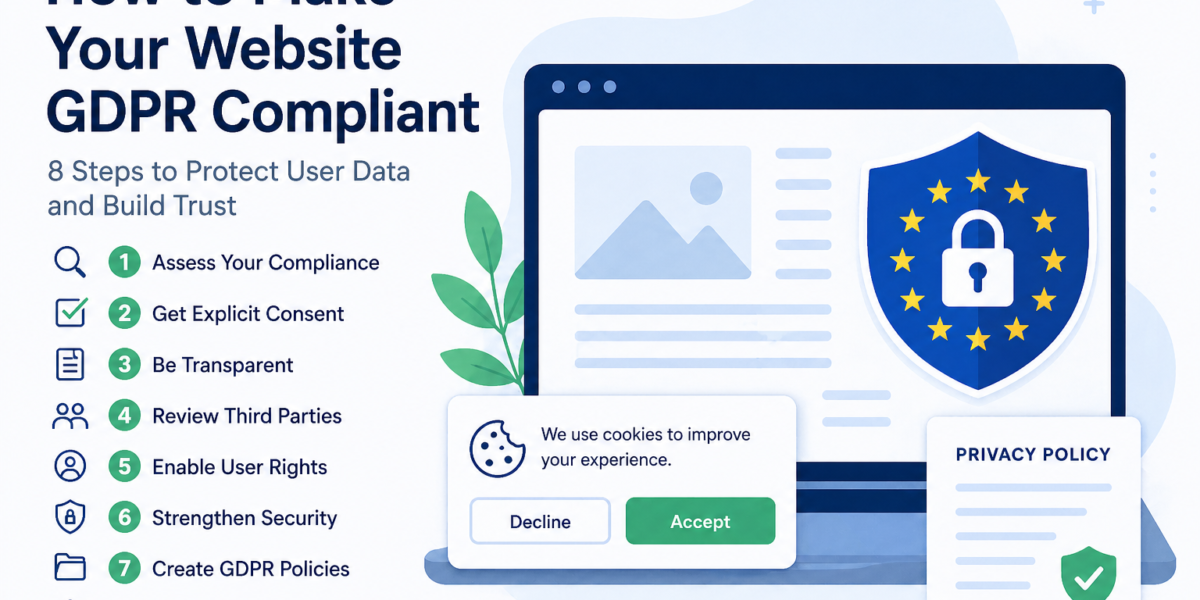
The General Data Protection Regulation, or GDPR, is one of the most important data privacy laws in the world. It sets strict rules for how organizations collect, process, and store personal data of individuals in the European Union.
If your website collects data from EU or UK users, even if your business is based in the United States, you are required to comply with GDPR requirements. Failing to do so can result in significant fines and reputational damage.
This guide breaks down exactly how to make your website GDPR compliant, with clear steps, practical tips, and a checklist you can follow.
- What Is GDPR and Why It Matters for Your Website
- Why GDPR Compliance Is Important
- 8 Steps to Make Your Website GDPR Compliant
- 1. Assess Your Current Compliance Status
- 2. Implement Clear User Consent Mechanisms
- 3. Be Transparent About Data Collection
- 4. Review Third-Party Tools and Integrations
- 5. Enable Data Subject Rights Requests
- 6. Strengthen Your Website Security
- 7. Create and Maintain GDPR Policies
- 8. Document and Prove Compliance
- Additional Tips to Maintain GDPR Compliance
- Final Thoughts
What Is GDPR and Why It Matters for Your Website
GDPR is designed to give individuals more control over their personal data. It requires organizations to be transparent about data usage and to implement strong safeguards to protect that data.
If your website collects information through forms, cookies, analytics tools, or account registrations, it likely falls under GDPR scope.
Even a small number of EU visitors can trigger compliance requirements. Because of this, many companies choose to apply GDPR standards globally to simplify operations and build user trust.
Turn compliance into a growth advantage.
Get expert help building a scalable security and compliance program without slowing down your team.
Why GDPR Compliance Is Important
GDPR compliance is not just about avoiding fines. It also provides real business benefits:
- Avoid penalties: Fines can reach up to €20 million or 4% of annual global revenue
- Build trust: Users are more likely to engage with websites that clearly protect their data
- Enable global expansion: GDPR compliance helps you operate in European markets
- Improve security posture: Strong data protection practices reduce overall risk
- Gain a competitive edge: Demonstrates maturity in security and compliance
8 Steps to Make Your Website GDPR Compliant
1. Assess Your Current Compliance Status
Start by understanding where your website stands today.
Review your data collection practices, privacy policies, and security controls. Identify what personal data you collect, why you collect it, and how it is stored and processed.
You should also determine your role:
- Data controller
- Data processor
- Or both
This step helps you identify gaps and prioritize what needs to be fixed first.
2. Implement Clear User Consent Mechanisms
GDPR requires explicit consent before collecting non-essential data.
This means users must actively agree, not just browse your site.
To stay compliant:
- Add a cookie consent banner
- Allow users to accept or reject non-essential cookies
- Make it easy to withdraw consent at any time
Consent should always be clear, specific, and easy to understand.
3. Be Transparent About Data Collection
Your website must clearly explain:
- What data you collect
- Why you collect it
- How it is used
- Who it is shared with
- How long it is stored
This information should live in a well-written privacy policy that is easy to access, usually in your footer.
Avoid legal jargon. Clear and simple language builds trust and meets GDPR transparency requirements.
4. Review Third-Party Tools and Integrations
Many websites rely on third-party tools like analytics platforms, CRMs, chat widgets, and payment processors.
These tools can introduce compliance risks.
You are responsible for how they handle data on your behalf.
To reduce risk:
- Audit all third-party tools
- Ensure they meet GDPR standards
- Limit the data you share with them
- Put proper agreements in place such as data processing agreements
5. Enable Data Subject Rights Requests
GDPR gives users specific rights over their data, including:
- Accessing their data
- Correcting inaccurate data
- Requesting deletion
- Restricting processing
Your website should provide a simple way for users to submit these requests, such as a contact form or dedicated email.
You also need internal processes to respond within required timeframes.
6. Strengthen Your Website Security
Protecting personal data is a core requirement of GDPR.
At a minimum, your website should include:
- HTTPS encryption
- Strong access controls
- Secure authentication practices
- Regular software updates and patching
- Monitoring and logging
You should also follow key principles:
- Privacy by design: Build security into systems from the start
- Privacy by default: Only collect the minimum data necessary
7. Create and Maintain GDPR Policies
Compliance requires documented policies that guide how your organization handles data.
Key policies include:
- Data protection and privacy policies
- Incident response plan
- Data retention policy
You should also test your incident response plan regularly. GDPR requires breach notification within 72 hours in many cases, so preparation is critical.
8. Document and Prove Compliance
GDPR is not just about doing the work. You must also prove it.
Maintain documentation such as:
- Records of processing activities
- Data access logs
- Vendor agreements
- Training records
- Risk assessments and DPIAs
Proper documentation ensures you are ready for audits and regulatory reviews at any time.
Ready to move forward with confidence?
We help teams build security programs that customers trust.
Additional Tips to Maintain GDPR Compliance
Assign Ownership for Compliance
Even if you are not required to appoint a Data Protection Officer, assigning ownership internally helps ensure accountability and consistency.
Use HTTPS Across Your Entire Website
HTTPS encrypts data between your users and your website, protecting it from interception and improving user trust.
Follow GDPR Data Protection Principles
Design your processes around these core principles:
- Lawfulness and transparency
- Purpose limitation
- Data minimization
- Accuracy
- Storage limitation
- Integrity and confidentiality
- Accountability
Conduct Data Protection Impact Assessments
If you process sensitive data or introduce new technologies, conduct a Data Protection Impact Assessment to identify and reduce risk before issues arise.
Anonymize or Minimize Sensitive Data
Reduce exposure by:
- Masking identifiable data
- Using anonymization techniques
- Limiting unnecessary data collection
Automate Compliance Where Possible
Manual compliance processes are time-consuming and prone to error.
Using a platform like Polimity can help automate:
- Vendor risk assessments
- Evidence collection
- Policy management
- Ongoing monitoring
Automation improves accuracy, saves time, and provides real-time visibility into your compliance posture.
Final Thoughts
Making your website GDPR compliant is not a one-time task. It is an ongoing process that requires continuous monitoring, updates, and improvement.
By following these steps, you can reduce risk, protect user data, and build trust with your audience while staying aligned with global privacy standards.
