
Understanding the cost of CMMC certification is critical for any business working with the Department of Defense or the Defense Industrial Base. With the final rule now in place, CMMC compliance is becoming a requirement for organizations that handle Controlled Unclassified Information and Federal Contract Information.
If your company plans to bid on or maintain DoD contracts, you will need to budget for CMMC. Costs can vary widely depending on your certification level, current security posture, and how complex your environment is.
This guide breaks down CMMC certification costs, what impacts pricing, and how to plan your budget effectively.
What Is CMMC and Who Needs It?
The Cybersecurity Maturity Model Certification is a framework developed by the Department of Defense to ensure contractors protect sensitive information.
CMMC applies to:
- Defense contractors and subcontractors
- Companies handling Controlled Unclassified Information (CUI)
- Organizations managing Federal Contract Information (FCI)
- Businesses operating under DFARS 252.204-7012 requirements
If your company is part of the defense supply chain, CMMC is not optional. Certification will be required to win and maintain contracts.
Turn compliance into a growth advantage.
Get expert help building a scalable security and compliance program without slowing down your team.
How Much Does CMMC Certification Cost?
CMMC certification costs depend on several factors, including your certification level, organization size, and current cybersecurity maturity.
Here is a realistic cost range by level:
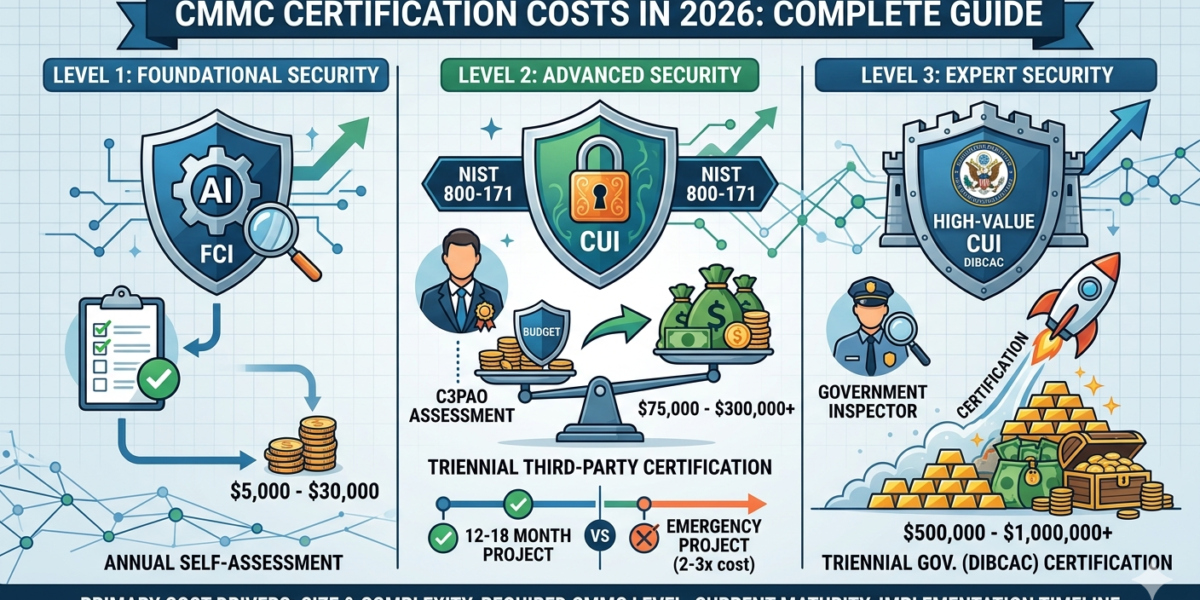
CMMC Level 1 Cost
Estimated cost: $5,000 to $15,000
Level 1 focuses on basic cyber hygiene and applies to companies that only handle Federal Contract Information.
Requirements are relatively simple, with around 15 to 17 security practices based on FAR 52.204-21. Most organizations can complete a self-assessment without hiring a third-party auditor.
Costs at this level are typically limited to internal effort, basic tooling, and minor remediation work.
CMMC Level 2 Cost
Estimated cost: $50,000 to $200,000 or more
Level 2 is the most common certification level and is required for organizations handling Controlled Unclassified Information.
This level aligns with the 110 controls outlined in NIST SP 800-171 and requires a formal third-party assessment conducted by a Certified Third-Party Assessment Organization.
Typical cost breakdown:
- Readiness assessment and gap analysis: $10,000 to $40,000
- Remediation and control implementation: $20,000 to $150,000 or more
- C3PAO assessment: $30,000 to $75,000
- Documentation and System Security Plan (SSP): $12,000 to $60,000
For many companies, remediation is the largest cost. If your current security program is immature, expenses can rise quickly.
CMMC Level 3 Cost
Estimated cost: $100,000 to $1,000,000 or more
Level 3 applies to organizations supporting highly sensitive Department of Defense programs.
In addition to the 110 controls from Level 2, Level 3 introduces enhanced requirements based on NIST SP 800-172. These controls focus on advanced threat protection and resilience.
Because of the complexity and strict requirements, Level 3 involves significant investment in security infrastructure, personnel, and ongoing monitoring.
Only a small percentage of contractors will need this level.
Key Factors That Impact CMMC Costs
CMMC costs can vary significantly depending on your organization. Understanding these variables helps you build a realistic budget.
Organization Size
Larger companies typically have more systems, users, and locations. This increases the effort required for implementation, documentation, and audits.
Current Cybersecurity Maturity
If you already follow frameworks like NIST SP 800-171, ISO 27001, or SOC 2, your costs will likely be lower. Companies starting from scratch should expect higher remediation expenses.
Scope of CUI
The more systems and users that interact with Controlled Unclassified Information, the more controls you will need to implement.
Reducing the scope of CUI can significantly lower costs.
Infrastructure Complexity
Complex environments with multiple networks, cloud systems, and integrations require more effort to secure and document.
Supply Chain and Vendors
If your business relies on subcontractors or third parties, you may need to account for additional compliance and risk management efforts.
How to Reduce CMMC Certification Costs
CMMC can be expensive, but there are practical ways to control costs without cutting corners.
Limit Your Scope
One of the most effective strategies is to reduce where CUI is stored and processed. Limiting access to specific systems and users can reduce both implementation and audit costs.
Use Managed Security Services
Working with a managed security provider can reduce the need for internal hiring while improving efficiency. This is especially helpful for smaller teams.
Invest in Automation
Compliance platforms can streamline documentation, track controls, and reduce manual effort. Automation can also help maintain continuous compliance over time.
Prepare Thoroughly Before Your Audit
Poor preparation leads to failed assessments and rework. Conducting a readiness assessment before your official audit can save both time and money.
CMMC Documentation Costs
Documentation is a critical part of CMMC compliance, especially for Level 2 and Level 3.
Your System Security Plan and supporting policies must clearly explain how your organization meets each control.
Typical options include:
- DIY approach: $5,000 to $15,000 in internal effort
- Templates: $2,000 to $5,000 for a starting point
- Consultant support: $15,000 to $40,000 for expert guidance
While doing it yourself may seem cheaper, incomplete or inaccurate documentation can lead to audit failures.
Ongoing CMMC Maintenance Costs
CMMC is not a one-time project. Maintaining compliance requires continuous effort.
Common ongoing costs include:
- Annual security reviews: $5,000 to $15,000
- Compliance monitoring and tooling: $10,000 to $30,000 per year
- Technology upgrades and patching: varies based on infrastructure
- Re-certification every three years: similar cost to initial assessment
Organizations should treat CMMC as an ongoing operational expense rather than a one-time investment.
How Polimity Helps with CMMC Compliance
Managing CMMC compliance can be complex, especially for growing companies with limited internal resources.
Polimity provides AI-driven GRC solutions designed to simplify the process. From gap assessments to documentation and continuous monitoring, Polimity helps organizations prepare for certification efficiently and maintain compliance over time.
With the right tools and guidance, companies can reduce risk, accelerate readiness, and stay competitive in the defense market.
Ready to move forward with confidence?
We help teams build security programs that customers trust.
Frequently Asked Questions
What are the three CMMC levels?
CMMC 2.0 includes three levels:
Level 1 focuses on basic safeguarding of Federal Contract Information
Level 2 covers Controlled Unclassified Information and aligns with NIST SP 800-171
Level 3 applies to highly sensitive programs and includes enhanced security requirementsIs CMMC certification required?
Yes. CMMC certification is required for companies that want to work with the Department of Defense and handle sensitive information.
How does CMMC compare to other frameworks?
CMMC is generally more rigorous than basic frameworks because it requires formal assessments and verification. While frameworks like ISO 27001 and NIST SP 800-171 provide guidance, CMMC enforces compliance through certification.
Can small businesses afford CMMC?
Yes, especially at Level 1. Small businesses can manage costs by limiting scope, using managed services, and planning their implementation carefully.
Final Thoughts
CMMC certification is becoming a critical requirement for companies in the defense supply chain. While costs can be significant, proper planning and smart scoping can make the process manageable.
Organizations that invest early in compliance will be better positioned to win contracts, reduce risk, and build long-term trust with government partners.
