
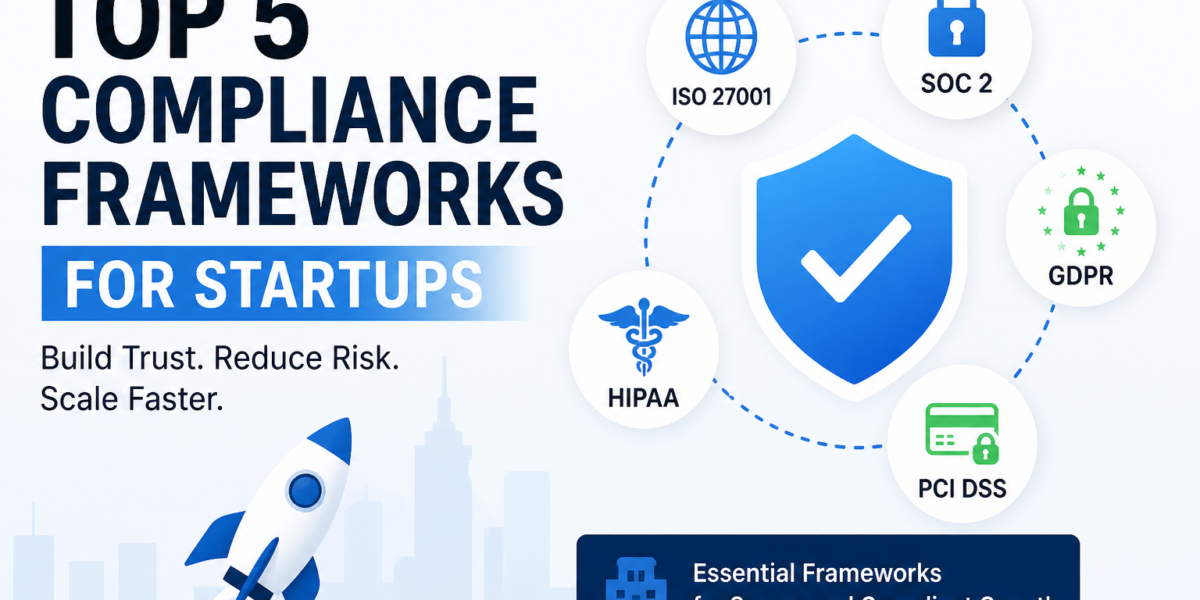
Startups move fast, but compliance cannot be an afterthought. Whether you are building a SaaS platform, handling customer data, or selling into enterprise markets, aligning with the right compliance frameworks early can unlock growth, build trust, and prevent costly setbacks later.
In this guide, we break down the top five compliance frameworks for startups, why they matter, and how to choose the right ones for your business. We also include a comparison of ISO 42001 vs PCI DSS to help you understand where AI governance fits into modern compliance.
Why Compliance Matters for Startups
Many founders see compliance as a burden, but it is actually a growth enabler. Strong compliance practices help you:
- Win enterprise customers faster
- Pass vendor security reviews
- Reduce legal and regulatory risk
- Build trust with users and investors
- Scale into new markets with confidence
If you are planning to sell B2B, especially to mid market or enterprise clients, compliance is not optional. It is expected.
Turn compliance into a growth advantage.
Get expert help building a scalable security and compliance program without slowing down your team.
1. SOC 2
Best for: SaaS startups and service providers handling customer data
SOC 2 is one of the most important frameworks for startups, especially in the United States. It evaluates how your company manages customer data based on five trust service criteria:
- Security
- Availability
- Processing integrity
- Confidentiality
- Privacy
Most startups begin with SOC 2 Type I and then move to Type II as they mature.
Why SOC 2 matters
SOC 2 is often required by enterprise customers before signing contracts. Without it, deals can stall or fall through completely. It is also one of the fastest ways to demonstrate that your startup takes security seriously.
When to start
Start preparing for SOC 2 as soon as you begin selling to other businesses or handling sensitive data.
2. ISO 27001
Best for: Startups with global ambitions
ISO 27001 is an international standard for information security management systems. It is widely recognized across Europe, Asia, and global markets.
Why ISO 27001 matters
- Opens doors to international customers
- Provides a structured, risk based approach to security
- Demonstrates long term commitment to compliance
Unlike SOC 2, ISO 27001 requires formal certification through an accredited auditor.
When to start
If you plan to expand globally or work with international clients, ISO 27001 should be on your roadmap early.
3. GDPR
Best for: Startups handling data from users in the European Union
The General Data Protection Regulation governs how personal data is collected, stored, and processed for EU residents.
Why GDPR matters
- Required by law if you handle EU user data
- Heavy fines for non compliance
- Builds strong privacy practices from day one
GDPR is not just a framework. It is a legal requirement, which makes it critical for startups with any global reach.
Key areas to focus on
- Data collection transparency
- User consent management
- Data subject rights
- Breach notification processes
4. HIPAA
Best for: Healthtech and startups handling medical data
If your startup deals with protected health information in the United States, HIPAA compliance is mandatory.
Why HIPAA matters
- Legal requirement for healthcare data
- Required for partnerships with healthcare providers
- Builds trust in a highly sensitive industry
Key components
- Administrative safeguards
- Physical safeguards
- Technical safeguards
When to start
Immediately if your product touches healthcare data in any way.
5. PCI DSS
Best for: Startups processing payments
PCI DSS applies to any company that stores, processes, or transmits credit card information.
Why PCI DSS matters
- Required by payment processors
- Protects against fraud and data breaches
- Essential for ecommerce and fintech startups
Key requirements
- Secure network architecture
- Data encryption
- Access controls
- Regular monitoring and testing
When to start
As soon as your startup begins handling payment data directly.
Ready to move forward with confidence?
We help teams build security programs that customers trust.
ISO 42001 vs PCI DSS: What Startups Need to Know
As AI adoption accelerates, startups are now facing a new compliance layer. This is where ISO 42001 comes in. Understanding how it compares to PCI DSS helps clarify when each framework applies.
What is ISO 42001
ISO 42001 is a framework focused on artificial intelligence governance. It helps organizations manage AI systems responsibly by addressing:
- Risk management for AI models
- Transparency and explainability
- Bias and fairness controls
- Ongoing monitoring of AI systems
This framework is especially relevant for startups building or integrating AI into their products.
Key Differences Between ISO 42001 and PCI DSS
1. Scope
- ISO 42001 focuses on AI systems and governance
- PCI DSS focuses on payment card data security
2. Use Case
- ISO 42001 applies to AI driven startups and SaaS platforms
- PCI DSS applies to any business handling credit card transactions
3. Risk Focus
- ISO 42001 addresses algorithmic risk, bias, and accountability
- PCI DSS addresses financial fraud and data breaches
4. Regulatory Nature
- ISO 42001 is a voluntary standard but increasingly expected
- PCI DSS is effectively mandatory if you process payments
When Should Startups Consider ISO 42001
You should start thinking about ISO 42001 if:
- Your product uses AI or machine learning models
- You handle automated decision making
- You want to build trust around AI usage
- Enterprise customers ask about AI governance
Can You Need Both
Yes, many startups will eventually need both frameworks.
For example:
- A fintech startup using AI for fraud detection may need PCI DSS for payment security and ISO 42001 for AI governance
- A SaaS platform with AI features and billing systems may also fall into both categories
These frameworks are not competitors. They address different risk areas and often complement each other.
How to Choose the Right Frameworks
Not every startup needs all frameworks right away. The right approach depends on your business model, customers, and growth plans.
Start with these questions
- Do you sell to other businesses
- Do you handle sensitive customer data
- Are you targeting enterprise clients
- Do you operate internationally
- Do you process payments or health data
- Do you use AI in your product
Typical startup path
Most SaaS startups follow a progression like this:
- SOC 2 for early trust and sales enablement
- GDPR for privacy compliance
- ISO 27001 for global expansion
- PCI DSS for payments
- ISO 42001 for AI governance
Common Compliance Mistakes Startups Make
Avoid these pitfalls as you build your compliance program:
- Waiting too long to start
- Treating compliance as a one time project
- Using manual processes that do not scale
- Ignoring documentation and evidence collection
- Underestimating audit readiness requirements
Compliance should be built into your operations, not bolted on later.
Final Thoughts
Compliance is no longer just a checkbox. For startups, it is a competitive advantage. The right frameworks help you close deals faster, reduce risk, and build a strong foundation for growth.
By focusing on SOC 2, ISO 27001, GDPR, HIPAA, PCI DSS, and now ISO 42001, you can cover the most critical areas of security, privacy, payments, and AI governance.
If you are building a startup in 2026, the question is not whether you need compliance. It is how quickly you can implement it and turn it into a growth driver.
