
SOC 2 compliance requirements are not a simple checklist. Unlike rigid standards, SOC 2 is built around flexible, risk-based criteria that evaluate how effectively your organization protects customer data.
SOC 2 is one of the most widely recognized security compliance frameworks, especially for SaaS companies, cloud service providers, and technology vendors serving enterprise or regulated markets. Achieving SOC 2 compliance signals to customers, prospects, and partners that your organization takes security seriously, manages risks proactively, and can be trusted with sensitive data.
However, passing a SOC 2 audit and receiving a clean, unqualified report can be challenging. Preparing for SOC 2 often requires careful coordination, proper documentation, and time-intensive evidence collection. Many companies struggle to balance daily operations with audit preparation, which can be costly and disruptive if not approached strategically.
This guide explains SOC 2, the compliance requirements, the Trust Services Criteria (TSC), differences between Type 1 and Type 2 reports, readiness assessments, common challenges, and best practices for a successful audit.
What Is SOC 2?
SOC 2, or System and Organization Controls 2, is a security compliance framework developed by the American Institute of Certified Public Accountants (AICPA). The framework evaluates how organizations manage sensitive data and whether they have the necessary controls in place to protect customer information.
Unlike a certification, a SOC 2 audit produces a report that demonstrates your controls’ design and effectiveness. Organizations often need a SOC 2 report to satisfy enterprise clients, participate in vendor risk assessments, or comply with contractual obligations.
SOC 2 applies primarily to technology companies, particularly those handling customer data, such as SaaS platforms, cloud services, fintech, and healthcare tech. Rather than focusing solely on technical infrastructure, SOC 2 evaluates people, processes, and technology together to ensure that your security posture is robust and reliable.
Turn compliance into a growth advantage.
Get expert help building a scalable security and compliance program without slowing down your team.
Trust Services Criteria (TSC) Explained
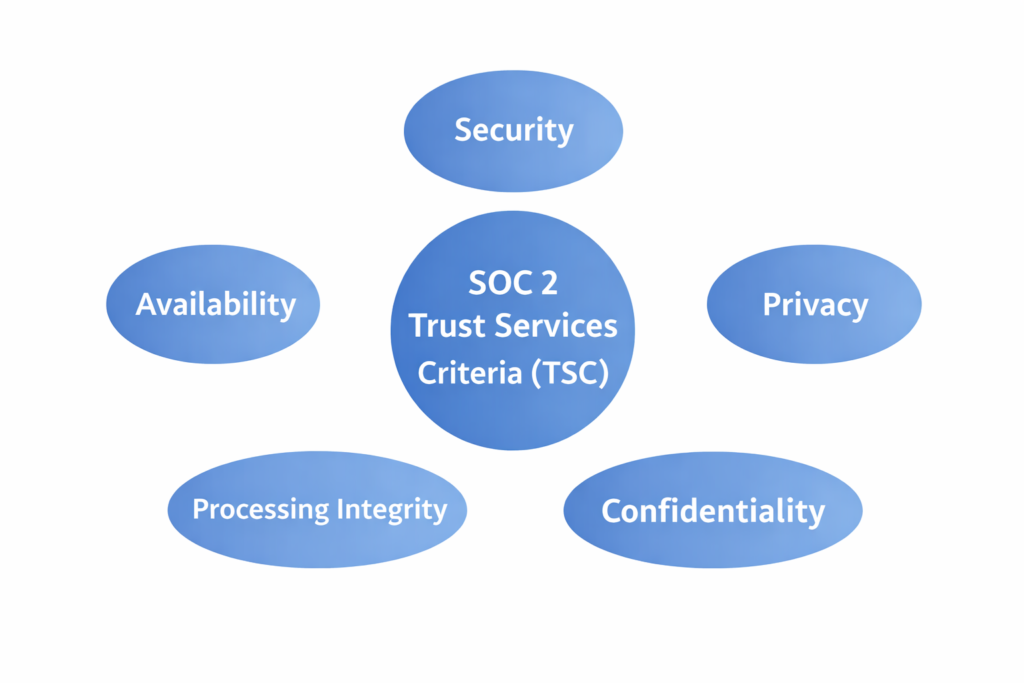
SOC 2 compliance is guided by the Trust Services Criteria, which auditors use to evaluate your organization’s security practices. There are five TSC categories: Security, Availability, Confidentiality, Processing Integrity, and Privacy. Of these, Security is always required, while the other four are scoped based on your company’s services and customer expectations.
These criteria serve as the foundation for SOC 2 audits, offering guidance on what controls and policies should exist while allowing flexibility to meet organizational and industry-specific needs.
Security
Security is the non-negotiable foundation of SOC 2. It focuses on protecting systems and data from unauthorized access, modification, or misuse. Security controls include logical and physical access management, risk assessments, change management, and vulnerability monitoring.
For example, controls must ensure that only authorized personnel can access critical systems, that security risks are continuously assessed, and that policies and procedures are effectively implemented across the organization. Security often aligns with frameworks like ISO 27001 and NIST, making it a critical starting point for any SOC 2 audit.
Availability
The Availability criterion ensures that your systems meet operational and uptime commitments. For companies promising 99.9% uptime in service agreements, this criterion is vital. It evaluates system performance, monitoring, and disaster recovery capabilities.
Auditors expect organizations to demonstrate that capacity planning, system monitoring, and incident response procedures are in place. For example, regular testing of backup and recovery procedures shows that you can maintain operations even during disruptions, which is essential for high-reliability environments.
Confidentiality
Confidentiality applies to sensitive information that is not personally identifiable, such as intellectual property, internal financial reports, or customer business plans. Organizations must establish processes for identifying, securing, and safely disposing of confidential information.
Auditors will review how confidential data is stored, encrypted, shared internally or externally, and ultimately disposed of, ensuring your organization meets contractual or legal confidentiality obligations.
Processing Integrity
Processing Integrity confirms that your systems perform as intended, producing complete, accurate, and timely results. This criterion is critical for applications in financial services, payroll processing, and analytics, where errors could directly affect stakeholders.
Auditors assess policies and procedures governing system inputs, outputs, error handling, and validation controls to ensure that data integrity is maintained throughout operational processes.
Privacy
The Privacy criterion focuses on the collection, use, retention, and disposal of personal identifiable information (PII), such as names, email addresses, phone numbers, and government IDs. This often overlaps with regulations like GDPR and CCPA.
Auditors review how your organization communicates privacy practices to data subjects, manages consent, and protects PII throughout its lifecycle. Companies processing customer data frequently include Privacy in their SOC 2 scope, especially when offering cloud-based services or SaaS products.
SOC 2 Type 1 vs Type 2
SOC 2 reports are issued in two formats: Type 1 and Type 2.
Type 1 evaluates the design of your controls at a single point in time. It is faster and less expensive, making it suitable for early-stage companies needing to quickly demonstrate security to customers.
Type 2 evaluates the operational effectiveness of controls over a period (usually 3–12 months). It is more comprehensive, provides stronger assurance to clients, and is the standard most enterprise customers expect. While Type 1 can unblock deals in the short term, Type 2 is the long-term goal for organizations seeking credible and reliable security validation.
SOC 2 Readiness Assessment
Before your SOC 2 audit, a readiness assessment is highly recommended. This pre-audit evaluation helps you identify gaps in controls, policies, and evidence, giving you a clear roadmap to prepare for the official audit.
During a readiness assessment, an auditor or consultant will:
- Review your existing controls against the relevant Trust Services Criteria
- Assess policies, procedures, and system configurations
- Identify missing controls or documentation
- Provide actionable recommendations for remediation
Completing a readiness assessment reduces risk, minimizes delays, and increases the likelihood of achieving an unqualified SOC 2 report.
Common Challenges in SOC 2 Compliance
Organizations often face challenges such as unclear control ownership, inconsistent evidence collection, and treating SOC 2 as a one-time project rather than an ongoing program. Other frequent obstacles include over-scoping audits and insufficient internal communication regarding security responsibilities.
The most successful SOC 2 implementations treat compliance as a continuous process, integrating security into everyday operations rather than waiting for an audit cycle.
Best Practices for SOC 2 Compliance
Achieving SOC 2 compliance efficiently requires strategic planning. Consider these practices:
- Start with a narrow scope, focusing on critical systems first
- Assign clear ownership for each control
- Document policies and evidence continuously, rather than collecting retroactively
- Align controls with business processes to ensure audit relevance
- Conduct internal reviews and mock audits before the official assessment
By following these steps, organizations can reduce audit friction and demonstrate security effectiveness confidently.
Turning SOC 2 Into a Business Advantage
SOC 2 compliance is not just a regulatory exercise—it is a marketable asset. Companies that maintain a robust SOC 2 program often experience shorter sales cycles, faster enterprise onboarding, and increased customer trust.
Approaching SOC 2 strategically ensures your organization earns an unqualified report consistently, unlocking growth opportunities while improving your security posture.
Polimity Services: Simplifying SOC 2 Compliance
Polimity helps fast-growing companies achieve SOC 2 compliance efficiently. From readiness assessments to ongoing compliance management, Polimity provides:
- Expert guidance on Trust Services Criteria and control mapping
- Audit preparation support, including evidence collection and documentation
- Continuous compliance tools to maintain controls year-round
- Customizable policies and templates aligned with your business and industry
By leveraging Polimity’s services, organizations can reduce audit preparation time, minimize operational disruption, and turn SOC 2 compliance into a strategic growth enabler.
Ready to move forward with confidence?
We help teams build security programs that customers trust.
