
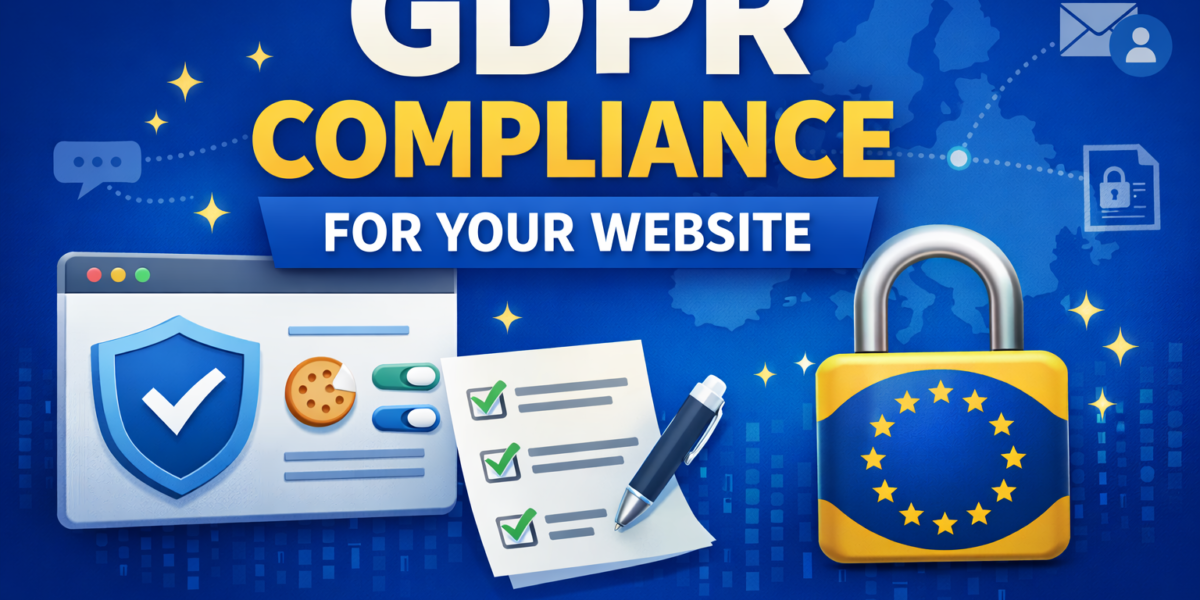
The General Data Protection Regulation (GDPR) is one of the most comprehensive data privacy laws in the world. It sets strict rules for how organizations collect, use, store, and protect the personal data of individuals in the European Union (EU).
If your website processes personal data from EU users—even if your business is based outside Europe—you are required to comply with the GDPR. Failing to do so can result in significant fines, legal action, and loss of customer trust.
In this guide, we’ll explain what GDPR compliance means for websites, why it matters, and the exact steps you can take to make your website GDPR compliant. You’ll also find a practical checklist and ongoing compliance tips to help you stay protected as regulations evolve.
Note: After Brexit, the United Kingdom adopted its own version of the regulation known as the UK GDPR. If your website serves users in both the EU and the UK, you must comply with both frameworks.
- What Is GDPR and How Does It Affect Websites?
- Why GDPR Compliance Matters for Your Website
- Steps to Make Your Website GDPR Compliant
- Step 1: Assess Your Current GDPR Compliance Status
- Step 2: Obtain Explicit User Consent Where Required
- Step 3: Clearly Explain Your Data Collection Practices
- Step 4: Review Third-Party Tools and Integrations
- Step 5: Provide a Clear Way for Users to Exercise Their Rights
- Step 6: Strengthen Website Data Security
- Step 7: Create Internal GDPR Policies and Procedures
- Step 8: Document and Prove GDPR Compliance
- Step 9: Define and Enforce Data Retention and Deletion Rules
- Step 10: Train Staff and Review Website Changes Regularly
- Additional Tips for Maintaining GDPR Website Compliance
- How Polimity Helps You Achieve GDPR Compliance
- Frequently Asked Questions
What Is GDPR and How Does It Affect Websites?
The GDPR is a data protection law designed to give individuals more control over their personal information. It applies to any organization that collects or processes personal data belonging to people in the EU or UK.
Personal data includes:
- Names
- Email addresses
- IP addresses
- Cookie identifiers
- Location data
- Account information
- Behavioral and analytics data
Because websites routinely collect this type of information through forms, cookies, analytics tools, and user accounts, most websites fall within the scope of GDPR.
Even if your business is located in the United States or elsewhere, GDPR still applies if:
- Your website targets EU or UK users
- You offer goods or services to people in those regions
- You track or monitor user behavior (such as analytics or advertising)
EU GDPR vs UK GDPR: What You Need to Know
| Your Website Collects Data From | You Must Comply With |
|---|---|
| Individuals in the EU | EU GDPR |
| Individuals in the UK | UK GDPR |
| Individuals in both | Both EU and UK GDPR |
Many organizations choose to apply GDPR standards globally to simplify compliance and reduce risk.
Turn compliance into a growth advantage.
Get expert help building a scalable security and compliance program without slowing down your team.
Why GDPR Compliance Matters for Your Website
If your website is subject to GDPR, compliance is not optional. Regulatory penalties can reach up to €20 million or 4% of global annual revenue, whichever is higher.
Beyond avoiding fines, GDPR compliance provides several business benefits:
- Builds customer trust: Transparent data practices improve credibility and user confidence
- Supports global expansion: GDPR-aligned systems make it easier to comply with other privacy laws
- Improves security posture: GDPR requires strong safeguards that reduce breach risk
- Creates competitive advantage: Many partners and customers prefer working with compliant vendors
- Steps to Make Your Website GDPR Compliant
Steps to Make Your Website GDPR Compliant
Step 1: Assess Your Current GDPR Compliance Status
Start by understanding how your website currently handles personal data.
Your assessment should include:
- Reviewing your privacy policy for clarity and accuracy
- Identifying what personal data is collected and why
- Confirming whether you act as a data controller, processor, or both
- Checking whether data collection aligns with GDPR principles
Using a structured compliance assessment or automated scanning tools can help identify gaps faster and prioritize remediation.
Step 2: Obtain Explicit User Consent Where Required
GDPR requires explicit and informed consent before collecting non-essential personal data.
This means:
- No pre-checked boxes
- No implied consent
- Clear opt-in actions
If your website uses cookies, analytics, marketing pixels, or collects email subscriptions, you must:
- Display a compliant cookie consent banner
- Allow users to accept or reject non-essential cookies
- Provide an easy way to withdraw consent at any time
Step 3: Clearly Explain Your Data Collection Practices
Transparency is a core GDPR requirement. Your website must clearly disclose:
- What data you collect
- Why you collect it
- How it is processed
- Who can access it
- Whether data is shared with third parties
- Whether data is transferred outside the EU or UK
- How long data is retained
- How users can exercise their rights
This information should be written in plain language and included in an easily accessible privacy policy.
Step 4: Review Third-Party Tools and Integrations
You are responsible for the data practices of third-party tools used on your website, including:
- Analytics platforms
- Payment processors
- CRM systems
- Marketing tools
- Chat widgets
- Hosting providers
To reduce risk:
- Verify each vendor’s GDPR compliance
- Limit shared data to what is strictly necessary
- Use Data Processing Agreements (DPAs)
- Ensure safeguards for international data transfers
Step 5: Provide a Clear Way for Users to Exercise Their Rights
Under GDPR, individuals have rights such as:
- Accessing their data
- Correcting inaccurate information
- Requesting deletion
- Restricting processing
- Data portability
- Objecting to certain uses
Your website should clearly list how users can submit these requests, typically through:
- A dedicated privacy email address
- A contact form
- DPO or privacy contact details
You must respond within GDPR time limits and document all requests and actions taken.
Step 6: Strengthen Website Data Security
GDPR requires organizations to protect personal data from unauthorized access and misuse.
Key security measures include:
- HTTPS encryption
- Role-based access controls
- Firewalls and antivirus software
- Secure authentication
- Regular patching and updates
GDPR also emphasizes:
- Privacy by design: Building privacy into systems from the start
- Privacy by default: Making the most privacy-friendly settings the default option
Step 7: Create Internal GDPR Policies and Procedures
Website compliance must be supported by internal governance.
Key policies include:
- Data protection policy
- Incident response and breach notification plan
- Data retention and deletion policy
- Vendor management procedures
Under GDPR, most data breaches must be reported within 72 hours, making tested incident response plans essential.
Step 8: Document and Prove GDPR Compliance
GDPR requires accountability, meaning you must be able to demonstrate compliance.
Important documentation includes:
- Records of processing activities (RoPA)
- Vendor contracts and DPAs
- Data access logs
- Employee training records
- Data protection impact assessments (DPIAs)
Automated compliance platforms can help centralize evidence and reduce manual workload.
Step 9: Define and Enforce Data Retention and Deletion Rules
GDPR requires organizations to keep personal data only for as long as it is necessary for the purpose it was collected. Holding onto data indefinitely, “just in case,” is a common compliance mistake.
Your website should clearly define:
- How long user data is retained
- When data is automatically deleted or anonymized
- What triggers deletion (account closure, inactivity, withdrawn consent)
Practical actions include:
- Setting automatic deletion timelines for form submissions and user accounts
- Periodically reviewing databases and backups for outdated personal data
- Documenting retention periods in your privacy policy
By enforcing retention limits, you reduce legal exposure, minimize breach impact, and align with GDPR’s storage limitation principle.
Step 10: Train Staff and Review Website Changes Regularly
Website compliance isn’t just a technical issue—it’s an operational one. Anyone who manages content, tools, or data on your website should understand basic GDPR requirements.
To maintain compliance:
- Provide GDPR awareness training for marketing, IT, and support teams
- Review new website features, forms, or integrations before launch
- Reassess compliance after major updates, redesigns, or vendor changes
Even small changes—like adding a new tracking script or contact form—can introduce GDPR risks if not reviewed properly.
Regular reviews help ensure your website remains compliant as your business grows and your technology stack evolves.
Additional Tips for Maintaining GDPR Website Compliance
Assign a Data Protection Officer (If Required)
A DPO is mandatory if you:
- Are a public authority
- Process large volumes of sensitive data
- Conduct large-scale monitoring of individuals
Organizations targeting EU or UK users from abroad may also need an EU or UK representative.
Use HTTPS Across Your Entire Website
HTTPS encrypts data in transit, protects user information, improves SEO rankings, and increases trust.
Conduct Regular Data Protection Impact Assessments
DPIAs are required for high-risk processing activities, such as behavioral tracking or automated decision-making.
Anonymize or Minimize Sensitive Data
Use techniques like:
- Data masking
- Aggregation
- Randomization
- Pseudonymization
Only retain data that is necessary and relevant.
Automate Compliance Where Possible
Manual GDPR compliance is time-consuming and error-prone. Automation helps with:
- Continuous monitoring
- Evidence collection
- Policy management
- Risk tracking
How Polimity Helps You Achieve GDPR Compliance
Polimity provides expert-led compliance and privacy solutions to help organizations confidently meet GDPR requirements and reduce regulatory risk.
With Polimity, businesses benefit from:
- Guided GDPR readiness assessments
- Website and vendor compliance reviews
- Policy development and customization
- Ongoing compliance monitoring
- Expert advisory support without unnecessary complexity
Whether you’re preparing for GDPR for the first time or maintaining long-term compliance, Polimity helps you build a scalable, audit-ready privacy program.
Ready to move forward with confidence?
We help teams build security programs that customers trust.
Frequently Asked Questions
Do I need a cookie banner for GDPR compliance?
Yes. Non-essential cookies require explicit user consent before being placed.
Is Google Analytics GDPR compliant?
Google Analytics can be used in a GDPR-compliant way, but only when properly configured and disclosed.
Does GDPR apply to US-based websites?
Yes, if they collect or process personal data from individuals in the EU or UK.
What happens if my website is not GDPR compliant?
You may face fines, enforcement actions, and reputational damage.
How can I check if my website is GDPR compliant?
You can conduct an internal audit or work with compliance experts who assess your website and data practices against GDPR requirements.
