As SaaS startups scale, one thing becomes clear fast. Security and compliance are no longer optional. Enterprise customers, investors, and regulators all expect proof that your company can handle data responsibly.
That proof comes in the form of GRC certifications.
The right certifications can accelerate sales, shorten procurement cycles, and build trust with larger customers. The wrong ones can waste time and budget.
This guide breaks down the most important GRC certifications for SaaS startups, what they cover, and when you should pursue them.
What Are GRC Certifications?
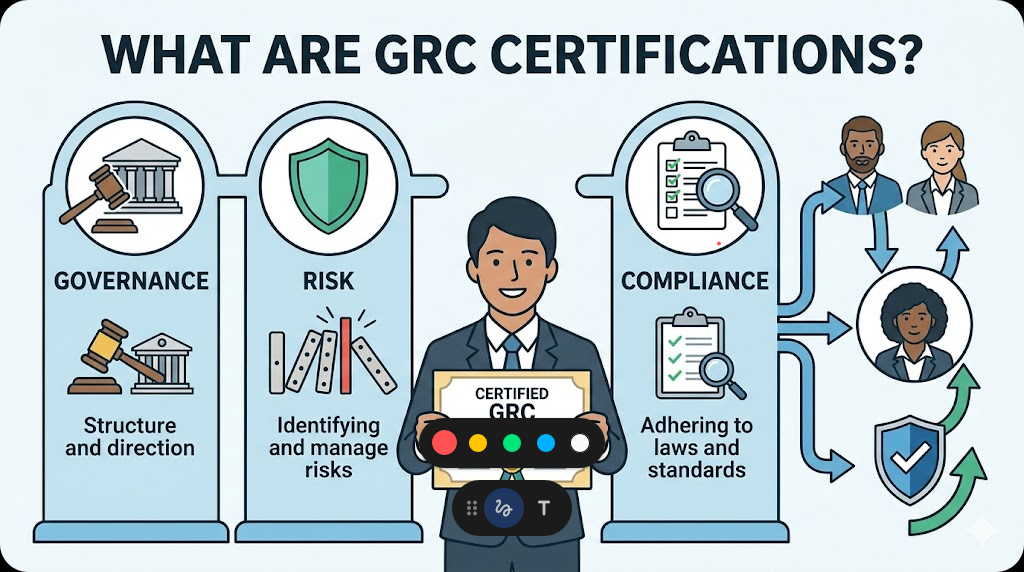
GRC stands for Governance, Risk, and Compliance. GRC certifications validate that your company has structured processes in place to manage risk, protect data, and meet regulatory requirements.
For SaaS companies, these certifications are often required to:
- Close enterprise deals
- Pass vendor security reviews
- Protect sensitive customer data
- Expand into regulated industries
In many cases, compliance is directly tied to revenue growth.
Turn compliance into a growth advantage.
Get expert help building a scalable security and compliance program without slowing down your team.
Why GRC Certifications Matter for SaaS Startups
Most early-stage startups ignore compliance until it blocks a deal. That is usually a mistake.
Enterprise buyers increasingly require proof of security before signing contracts. In fact, frameworks like SOC 2 have become “table stakes” for SaaS companies selling to larger organizations.
Without certifications, you may face:
- Long security questionnaires
- Delayed deals
- Lost enterprise opportunities
- Reduced trust with prospects
With the right certifications, you can:
- Close deals faster
- Enter new markets
- Build long-term credibility
- Reduce security risks
Top GRC Certifications for SaaS Startups
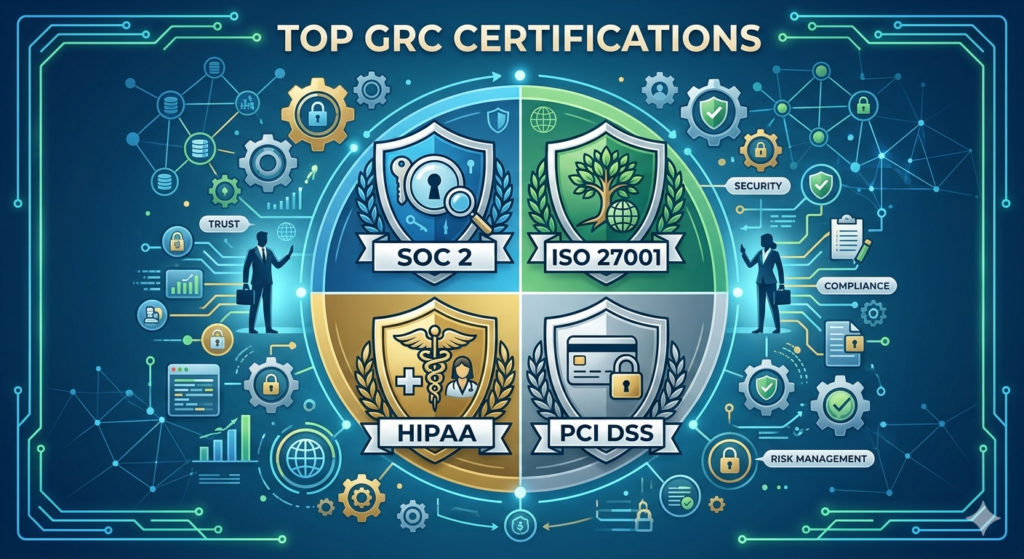
Here are the most important certifications and frameworks SaaS startups should consider in 2026.
1. SOC 2 (System and Organization Controls 2)
SOC 2 is the most important certification for SaaS companies targeting enterprise customers.
It evaluates how well your organization protects customer data based on five Trust Services Criteria:
- Security
- Availability
- Processing Integrity
- Confidentiality
- Privacy
There are two main types:
- SOC 2 Type I: Snapshot of controls at a point in time
- SOC 2 Type II: Proves controls work over time
Why it matters:
SOC 2 is often the first certification enterprise buyers ask for. If you sell B2B SaaS in the U.S., this is usually your starting point.
2. ISO/IEC 27001
ISO 27001 is a globally recognized standard for information security management systems.
It provides a structured framework for managing risks, implementing controls, and continuously improving security practices.
Key features include:
- Risk assessment and mitigation
- Security policies and procedures
- Continuous monitoring and improvement
Why it matters:
If you sell internationally or work with global enterprises, ISO 27001 is often preferred. It is widely recognized across Europe and other regions.
3. ISO/IEC 42001 (AI Management Systems)
ISO 42001 is a newer standard focused on AI governance.
It helps companies manage risks related to AI systems, including:
- Model transparency
- Bias mitigation
- AI lifecycle management
- Risk monitoring
Why it matters:
If your SaaS product uses AI, this certification is becoming increasingly important. It shows buyers that you manage AI responsibly.
4. HIPAA (for Healthcare SaaS)
HIPAA is a regulatory requirement, not a certification, but it is critical for SaaS companies in healthcare.
It governs how Protected Health Information is stored, processed, and transmitted.
Why it matters:
If you handle healthcare data in the U.S., HIPAA compliance is mandatory. It is often required before any deal can move forward.
5. PCI DSS (for Payments)
PCI DSS applies to companies that process or store credit card data.
It includes requirements for:
- Secure payment processing
- Data encryption
- Access controls
- Monitoring and logging
Why it matters:
If your SaaS platform handles payments, PCI DSS compliance is required to operate securely and legally.
6. CMMC (for Defense and Government SaaS)
The Cybersecurity Maturity Model Certification is required for companies working with the Department of Defense.
It includes multiple levels based on the sensitivity of data handled.
Why it matters:
If you sell to government or defense customers, CMMC is mandatory.
7. CSA STAR (Cloud Security Alliance)
CSA STAR is a cloud-focused certification that builds on existing frameworks like ISO 27001.
It emphasizes:
- Cloud security controls
- Transparency
- Risk management
Why it matters:
It is especially useful for SaaS companies that want to differentiate in cloud security.
8. NIST Cybersecurity Framework (NIST CSF)
NIST CSF is not a certification in the traditional sense, but it is widely used as a baseline framework.
It focuses on five core functions:
- Identify
- Protect
- Detect
- Respond
- Recover
Why it matters:
Many other frameworks, including CMMC and ISO standards, align with NIST. It is often used as a foundation for building a security program.
Ready to move forward with confidence?
We help teams build security programs that customers trust.
How to Choose the Right GRC Certifications
Not every startup needs every certification.
The right choice depends on your customers, product, and growth stage.
Start with SOC 2 if:
- You sell to U.S. enterprise customers
- You need to pass vendor security reviews
- You are building a B2B SaaS product
Add ISO 27001 if:
- You are expanding internationally
- You want a globally recognized standard
- You already have SOC 2
Add industry-specific frameworks if:
- Healthcare → HIPAA
- Payments → PCI DSS
- Government → CMMC
- AI-heavy product → ISO 42001
Many frameworks overlap significantly. For example, SOC 2 and ISO 27001 share around 70 percent of controls, which allows companies to reuse work across certifications.
Building a GRC Roadmap for SaaS Startups
A typical path for SaaS companies looks like this:
- Start with a basic security foundation (often aligned with NIST CSF)
- Achieve SOC 2 Type I, then Type II
- Expand to ISO 27001 for global credibility
- Add industry or product-specific certifications
This phased approach helps avoid over-investing too early while still supporting growth.
Common Mistakes to Avoid
Trying to do everything at once
Startups often over-scope compliance. Focus on what your customers actually require.
Treating compliance as a checkbox
Certifications are not just about passing audits. You need real controls and processes in place.
Waiting too long
Many startups only pursue compliance after losing deals. Starting earlier can prevent this.
GRC certifications are frameworks that help SaaS companies manage governance, risk, and compliance. They show that your business has the right security controls and processes in place to protect customer data and meet regulatory requirements.
Most SaaS startups start with SOC 2. It is widely expected by enterprise customers and helps pass vendor security reviews. From there, companies often expand to ISO 27001 or other frameworks based on their market.
SOC 2 Type I can take around 1 to 3 months, while SOC 2 Type II usually takes 3 to 6 months. ISO 27001 typically takes 4 to 12 months depending on your current security maturity and scope.
They are not always legally required, but they are often necessary to close enterprise deals. Many buyers will not move forward without proof of compliance and security controls.
Final Thoughts
GRC certifications are no longer optional for SaaS startups that want to scale.
They are a key part of building trust, closing enterprise deals, and reducing risk.
The best approach is not to chase every certification. It is to choose the right ones based on your business model and grow your compliance program over time.
Start with what your customers need today, then build toward what you will need tomorrow.
